Book your 2026 & 2027 adventures Risk free.
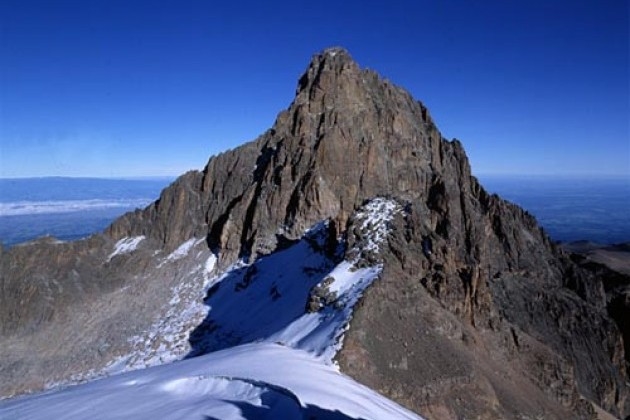

Mount Kenya Natural HistoryMount Kenya is Africa’s second highest mountain at 5,199m (17,058 feet) and the highest of all Kenya Mountains. Mount Kenya is roughly circular, about 60km across at the 200mm contour, where the steep font hills rise out of the gentler slopes of the centered highlands. At the centre of the massif, the main peaks rise sharply from around 4,500m to the main summit of Batian 5,199m, Nelion 5,188m and point Lenana 4,985m. Other major summits on the mountain include Point Piggott 4,957m, Point Dutton 4,885 and Point John 4,883m. Of the three main peaks (Batian, Lenana and Nelion), only point Lenana can be reached by trekkers and the other two being only for technical climbers.
Mount Kenya is the second highest peak in Africa and stands somewhat unjustly in the shadow of it's taller neighbour Kilimanjaro, which lies some 320km away in the south and is visible on a clear day. Kili may see much more traffic — due to the possibility of summitting via several non-technical trekking routes and due to the sometimes dubious honour of being one of the Seven Summits — but Mount Kenya offers a wealth of excellent and diverse climbing possibilities on rock, snow and ice.
The rock on Mount Kenya can be of variable quality but is at it's best high on the mountain where the syenite rock is similar to granite — rough, hard and well endowed with features.
Apart from the superb climbing potential on Mount Kenya, its tarns and alpine meadows; exotic, equatorial, high-altitude vegetation; sunbirds, hyrax and soaring eagles make the walk around the peaks one of the most beautiful expeditions in the East African mountains.
After the cultivated farmlands on the lower slopes the trails pass through the rain forest, rich in trees of many species but noticeably camphors, then onto a bamboo zone growing to heights of more than 12m or more up through open moor land before reaching the moonscape of higher slopes. The forests are rich in wildlife including elephant, buffalo and monkeys with even the moor lands offering a long list of mammals including the rock hyrax, the nearest living relative of the elephant.
Mt. Kenya is an ancient volcanic mountain much older than Mt. Kilimanjaro. It’s believed to have once reached well above 600m. What is left today is volcanic plug which erosion has fashioned into the complex jagged outline of the central peaks.
Getting to Mount KenyaMount Kenya is approximately 200km north of Nairobi, the capital of Kenya, and is comfortably accessible by road using a variety of transport options — buses, mini buses, taxi cab or a car hire will get you close to the mountain on the tarred roads to the nearest town: Naromoru town for Naro Moru route, Nanyuki town for Sirimon route and Chogoria town for Chogoria route.
The last stretch from the nearest town to the various trailheads (typically ± 25km) will be on dirt roads and these can be in poor condition (especially in wet weather) and require a 4WD, or an approach on foot.
When to Trek Mount KenyaAlthough, Mount Kenya can be climbed all year round, the highest rainfall occurs between late March and the middle of May, and slightly less between late October and mid December. Maximum rainfall occurs in the forest belt and on the south-east side of the mountain where it reaches 2500mm. per year at 3000m. Rain and, higher up, snow can however be encountered at any time of year — even in the driest periods (January and February). Normally the drier seasons are associated with clear, dry weather which can last for many days on end. The best weather is generally in the mornings, and convectional rainfall, if any, tends to come in the mid-afternoon.
Temperatures vary considerably with height and with time of day. At 3000m. frosts can be encountered at night while day temperatures range from 5 to 15°C. Night time temperatures on the summit are well below freezing. The south-facing side of Mount Kenya receives more sunshine in the December to March period. During this time rock climbs are «in-condition» and snow and ice climbs gradually deteriorate. In the June to October period the north-facing rock climbs and south-facing ice climbs are best.
It's safest to climb Mt. Kenya during the dry seasons: January — February and August to September off the most reliably fine weather. The main routes are likely to be more crowded at this time of the year. If you favor complete solitude over the sunny skies, try going slightly off the peak season. It’s best to avoid the two rainy seasons from mid March until June and from late October to the end of December.
Mount Kenya VegetationMount Kenya is home to some fascinating high-altitude alpine vegetation including giant groundsels and lobelias.
In the lower-altitude forest zone trekkers may come across some rather large and uncompromising African wildlife such as elephants and buffalo — fortunately these are mostly active only at night. Lions, leopard, rock hyrax, various antelope species and a wide range of other creatures large and small occur in the park.
Mount Kenya Forest Vegetation And Coverage In Percentage:
Bamboo — 10%
Bamboo and Forest Mix — 23%
Forest — 32%
Bushy Forest — 11%
Grassland — 8.5%
Plantation — 9%
Other — 6.5%
Mount Kenya climbing Routes/ItinerariesThere are three main routes, which penetrate the forest and the moorland. The routes are Naromoru route, Sirimon route and Chogoria route and each of which has something different to offer.
Climbing Mount Kenya Naromoru route — The fastest route to point Lenana but not as scenic as the other two. It is often overcrowded with many climbers since it's the most popular route compared to Chogoria route and Sirimon route.
Mount Kenya Climbing Chogoria route — The most scenic and interesting of the three main routes on the mountain.
The route passes the enchanting Hall Tarns and looks down sheer cliffs into the spectacular Gorges Valley and onto the beautiful Lake Michaelson.
Climbing Mount Kenya Sirimon route — The least used of the three main routes, but features the most gradual ascent profile and best acclimatisation options and above all the most interesting since its on the drier side on the mountain. The route passes through impressive Yellowwood forests in the lower reaches and features abundant wildlife and beautiful alpine scenery higher up.
There are other four routes up Point Lenana but are least known and used. These are: Burguret Route, Timau Route, Meru Route and Kamweti Route
Note: The normal pattern of weather on Mount Kenya is for clear mornings with mist closing in from 10:00am although this can clear by evening. Therefore, early morning starts are the order of the day with a 2am start for the final ascent to point Lenana, if you want to catch the sunrise.
Additional
Lake Rutundu and Lake Alice are both found in the Mount Kenya National Park on the northern slopes of Mount Kenya, at 12,200 feet, just above the forest line surrounded by alpine country. The striking alpine is world away from the next-door jagged moorlands. Lake Rutundu and Lake Alice are both stocked with rainbow trout which gives an exceptional chance for fishing. a residence for rare bird life and vegetation. Rutundu is not only a nature lover's bliss, but is also an idea spot for fisherman and hikers.
Recreational activities
Trout fishing,Horse riding and Nature walks Birdwatching, Boating, Fishing river,Fishing lake,Fishing-trout,Walking.
Accommodation consists
Two log cabins, with open fires, en-suite bathrooms and flush toilets. One room is attached to the sitting/dining area, veranda and kitchen. The other is separate from the main building. Rutundu can accommodate four people comfortably, but has a sleeping capacity of eight.
Programme
1. Pick up from Airport or Nairobi in the morning. Drive to Chogoria Village (3hrs), visit the market and have lunch in a restaurant before driving in a 4WD vehicle up the rough forest track to the Meru Mt Kenya Bandas. Short game-viewing walk in the Parklands in the afternoon.
2. Gentle walk to the Nithi Gates, explore the Nithi Falls and Gorge after lunch.
3. Walk up the ridge mintos hut 4200n m
4. Hike to the Summit 3pm.point lenana 4985 m
5. Complete the «Round the Peaks Circuit» past several beautiful tarns to reach Shipton Camp.
6. Descend the Sirimon Route to Judmeier Camp at the upper edge of the forest belt.
7. Continue down the Sirimon Gate and waiting transport. Drive back to Nairobi (to hotel or Airport) with lunch en-route.
our itinerary for,sirimon down chogoria ,narumoru down chogoria is available on request


