Book your 2026 & 2027 adventures Risk free.


Day 1: Arrival Delhi
Arrival Delhi : This day on arrival at New Delhi International Airport Delhi I will meet you. Transfer to your hotel in Delhi for the overnight stay. If you have arrived in the day time then the day is free to yourself. Go around the lanes and the streets of this busy town and catch some glimpses of Indian life in a Metro city.
We will see you at dinner for the briefing of the trip.
Lodging Delhi Home Stay
Day 2: Delhi — Shimla
Be ready at 0630 am as our representative shall be arriving there to assist you to drive to New Delhi railway station where you will be boarding Shatabadi Express to Chadigarh. The train leaves at 0740 am and arrives Chandigarh at 1120 am. Breakfast is on board.
On arrival at Chandigarh your I, who is going to accompany you to the trip will meet you. It is a 4 hours journey to Shimla. After 30 kilometers at Kalka, a busy town in the foothills, you enter the hills and ascend to Shimla. The drive is through the green slopes and the villages. We stop at Barog for lunch / afternoon snacks.
Arrive Shimla at 4 pm and check into your hotel. Shimla is a lovely town and has been the Summer Capital of the British before 1947. Evening you are free to stroll at the Mall or just go around your hotel.
We will have dinner at The Mall Road so see you.
Day 3: Shimla
Shimla is a Walker's paradise. Many people coming to Shimla regret if they miss it, so we keep here two nights for you so that you can walk through the Heritage Lanes of Shimla with your guide. There are beautiful Churches, A Viceregal Lodge now called Institute of Advanced Study, Army Heritage Museum, Annandale Ground, Gaiety theater and of course The Mall road — a busy street but meant only for the pedestrians.
Lunch at the Goofa Restaurant.
Day 4: Shimla — Sarhan
Distance: 175 km. Driving Time: 6 hours.
The drive is through the Apple orchards, lush landscape and over Narkand — a small but busy town at the height of 9000 feet.
Early morning breakfast, Sarahan, a beautiful village surrounded by apple orchards and dominated by Shrikhand Mahadev Peak (5155 M/ 16,912 feet) which resembles the «Shivling.» We visit the Bhimakali Temple, a wonderful mixture of Buddhist and Hindu architecture. It is very sacred to both communities. The Bhimakali goddess idol is approximately 200 years old.
Day 5: Sarahan — Chitkul
Distance: 120 km. Driving Time: 6 hours.
Sangla Valley, also known as Baspa Valley, is by far the most beautiful valley of Himachal Pradesh, full of wooded slopes and surrounded by green fields and high mountain peaks as far away as Chitkul, the last inhabited village in this valley.
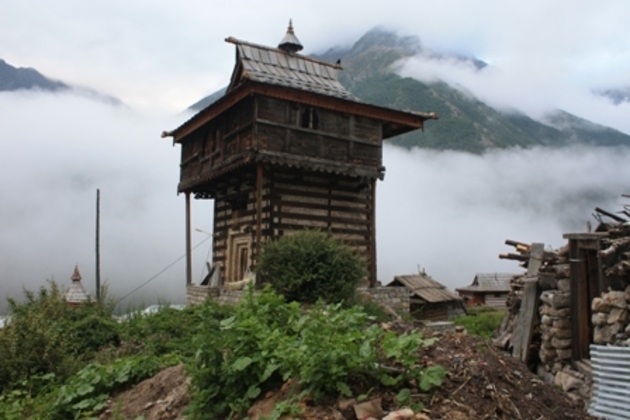
Chitkul is the last village in Sangla Valley and still displays the actual wooden houses and their replicas. In the afternoon walk through the village and explore its lanes.
Day 6: Chitkul — Kalpa
Distance: 70 km. Driving Time: 3 hours.
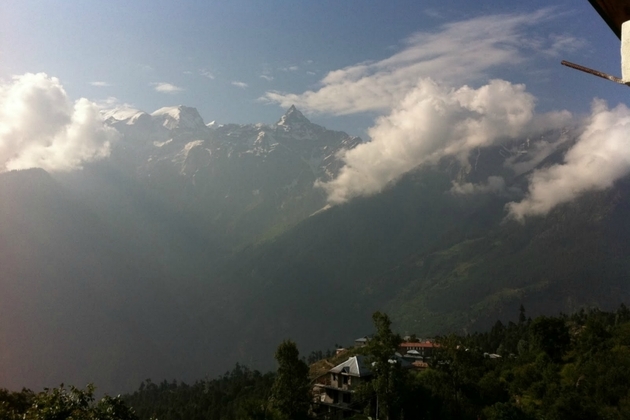
Drive to Kalpa. Enroute visit Rakcham and Kamru villages in the Sangla Valley. Looming above Kalpa village is the impressive Mt. Kinner Kailash (6050 M/ 19,850 feet). Arrive in time for lunch.
Afternoon: walk the Old Hindustan Road to Roghi Village. Overnight at the beautiful Kalpa Villa, situated at the base of Mt. Kinner Kailash.
Day 7: Kalpa – Telangi — Kalpa
After breakfast walk around the villages in and around Kalpa. These are the ancient and exquisite villages of Chini, Kothi, Pangi and Telangi.
Day 8: Kalpa — Nako
Distance: 105 km. Driving Time: 5 hours.
Visit to Nako subject to road connectivity, otherwise we drive from Kalpa direct to Tabo. The village of Nako lies at an altitude of 3625 meters (11,893 feet), high above the last stretch of the Spiti Valley. It was once a very important center of Buddhism in the region. There are different small sized temples belonging to different periods between the 11th and 12th centuries distributed all over the village, including a monastic complex on its western edge. Boasting four temples and a number of additional buildings, this complex preserves the earliest artistic heritage. The austere and un ornamented exteriors of the buildings give little hint of the important artistic and religious legacy that lies within the walls.
Day 9: Nako — Tabo
Distance: 70 km. Driving Time: 4 hours.
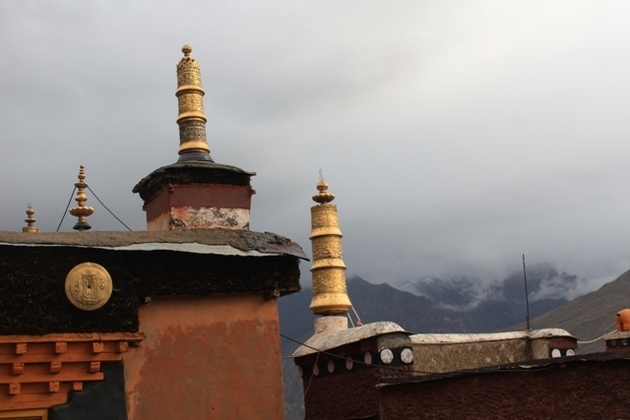
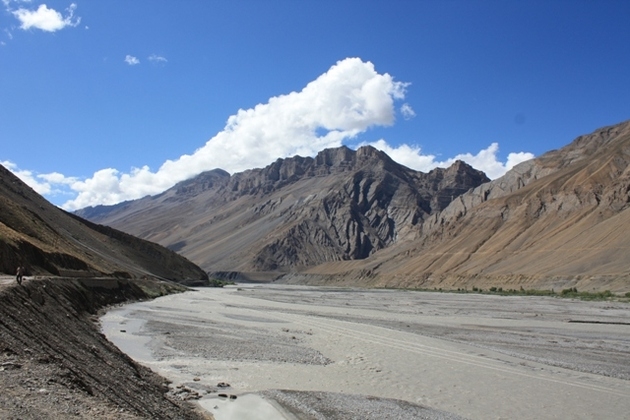
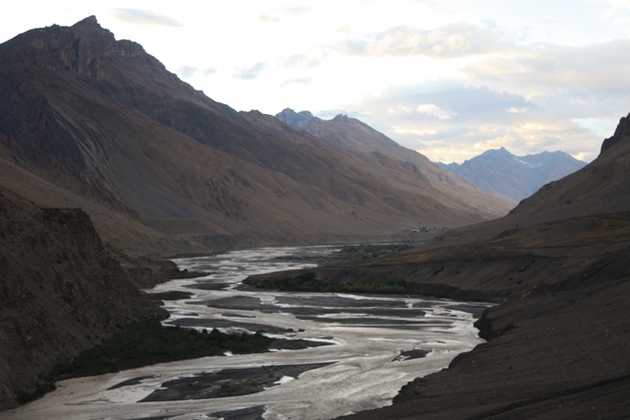
Today we enter the Spiti Valley. Geographically and archeologically, Spiti is a living museum. The mountains are devoid of any vegetation due to erosion by wind, sun and snow over thousands of years. Our vehicles climb up to the village of Tabo (3050 M/ 10,006 feet). Built in the year 996 AD, the Chos Khor Monastery at Tabo is the largest monastery in Spiti and one of the few remaining examples of the Golden Period of Buddhist Culture in the Himalayan Region. The wall frescos of the monastery are comparable in their antiquity and quality to those of the Ajanta caves, hence they are called the Ajanta of the Himalayas. It houses more than 100 Lamas, a large number of scriptures and pieces of art, wall paintings, tankhas and stucco. We will reach Tabo for lunch. In the afternoon and evening we will visit the monastery and village.
Day 10: Tabo — Kaza
Distance: 70 km. Driving Time: 4 hours.
Rise early if you want to join the monks in morning worship at Tabo monastery (5 min walk through the village).
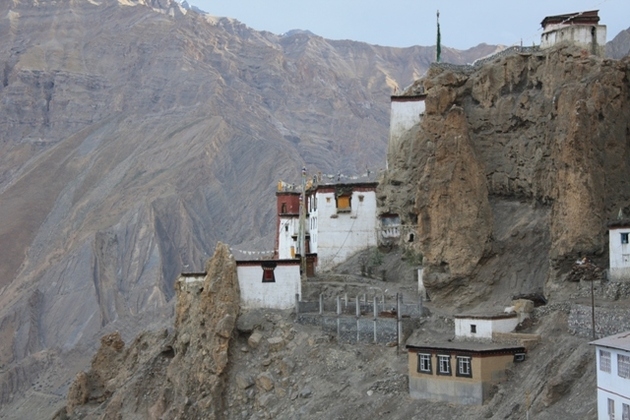
After breakfast we drive to kaza. On teh way we shall visit Dhankar, the ancient capital of Spiti. Dankar Gompa (3800 M/ 12,467 feet) was built in the 12th century. This hilltop fort dominates the scene, and once served as a jail. It contains more than 160 scriptures of Lamas and Buddhists in the Bhoti language. A statue of Dhyan Buddha consisting of four complete figures seated back to back is the main attraction of this four to five century-old monastery. Unfortunately, the ancient Gompa, situated on the very edge of the peak, is deteriorating. Entering the interior may be restricted in the very near future. They have shifted the main monastery to a new complex at the entrance of the village. His Holiness the Dalai Lama inaugurated this temple in June 2004.
Then continue our drive to Kaza. On the way we shall visit to Lhalung in Lingthi Valley. It is a magnificent village of 45 houses. In this village stands the second most interesting monastery of Spiti. At some spots fragmentary remains of a wall encircling all the buildings can be found. The monastic site of Lhalung once consisted of nine temples. Together with the unusually rich interior of Lhalung’s main chapel and the fact that the building of the temples is also attributed to Rinchen Zangpo, it may suggest that the temple site of Lhalung, like Tabo, was designed as a Chokhor site, a place for learning and debate as opposed to a simple chapel for worship by the local people.
Day 11: Kaza
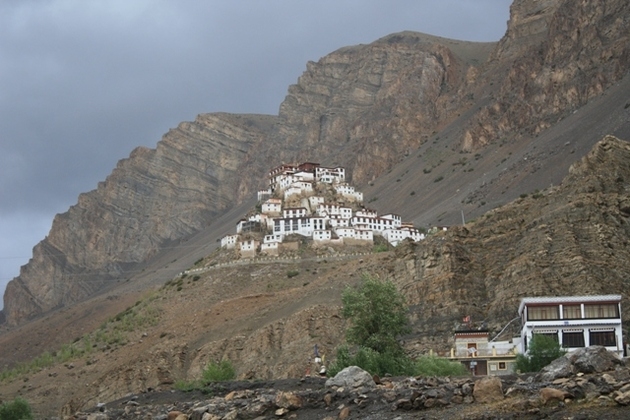
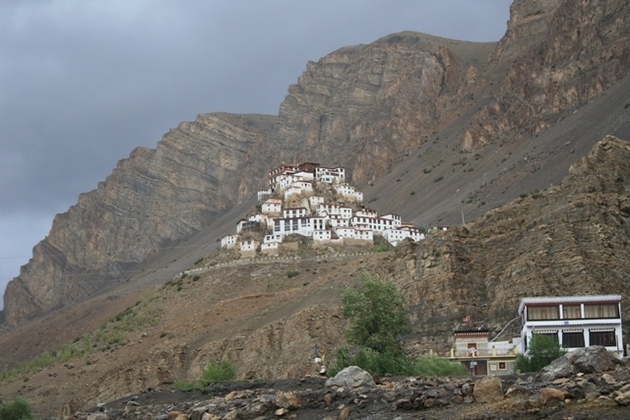
Morning after breakfast we visit to Kye Monastery. Tehn drive to Vilalge Kibber and Vilage Gete from where the view of Spiti Valley is just astounding.
Afternoon drive to Langcha, Komic and Hikkim Villages. In all these Hikkim is the highest village (4587 meters) in the world that is connected by road, electricity, eater and telephone.
Day 12: Kaza — Manali
Distance: 200 km. Driving Time: 9 hours.
Drive over the famous Kunzum Pass, enroute visit Lahaul Valley, between Kunzum and Rohtang. The drive offers magnificent views. Drive to Manali over Rohtang La (3980 M/ 13,058 feet). At Rohtang Pass we will relax and enjoy the breath-taking beauty; a guided horse ride up the mountain is optional.
Day 13: Manali
Morning we drie to Dhungri Templ in the Cedar forest. And then drive to Naggar to visit Naggar Castle and Reorich Art Galley.
Afternoon an easy strolling at the Mall. Free for shopping.
Day 14: Manali — Taragarh
Distance: 180 km. Driving Time: 6 hours.
Drive through Kullu to Kangra — the Valley of Temples. Stay at Taragarh Palace, the former Palace of the King of Jammu. Now converted into a Heritage hotel.
Evening visit the most ancient / oldest existing Shiva temples at Baijnath. Just below the village, a road to the west leads to a tiny Tibetan settlement. We will visit the Sherabilling monastery and hear the award-winning chants of the monks (2003 GRAMMY Award Winner for Best Traditional World Music Album). Sherab Ling Monastery is nestled in the gentle pine-forested foothills of northern India's Kangra Valley, the seat of its founder His Eminence Ti Situpa XII, a leading Tibetan Buddhist teacher and peace campaigner. Here the monks perform prayer ceremonies as part of their daily lives, originating many centuries ago in the great Buddhists monasteries of Tibet. The monks begin their day with the Lineage Prayer, offering respect to a line of great meditation practitioners going back as far as the 7th century. The Mahakala Ceremony is part of each day's closing ritual in which the monks ask for purification and dedicate their blessings to all sentient creatures.
Day 15: Taragarh — Dharamsala
Distance: 40 km. Driving Time: 1.5 hours.
Enroute we visit the institute of Tibetan Arts and Handicrafts in Norbulingka. Upon arrival, we visit the center of Tibetan Medicines and Astrology, time permitting.
Evening: you are free to explore the Tibetan Markets.
Day 16: Dharamsala — Amritsar
Distance: 175 km. Driving Time: 5 hours.
Early morning (6 am) walk to the Dalai Lama’s monastery to attend the monks’ puja; afterwards circumabulate the monastery complex along with the locals. Return to hotel for breakfast.
After breakfast, we drive to Amritsar, in the state of Punjab, in the Himalayan foothills called the Shivaliks. Amritsar, home of the Golden Temple, is one of the most ancient and fascinating cities in India. It is an important seat of Sikh history and culture. Being the gateway for travelers coming to India on the overland route from Central Asia, it soon became the center of various commercial activities. The Golden Temple was founded by the fourth Guru of the Sikhs, Guru Ramdas, and completed by his successor Guru Arjan Dev. It is famous for its full golden dome, one of the most sacred pilgrim sites for Sikhs. The Mandir is built on a 67-foot square of marble and is a two-storied structure. Maharaja Ranjit Singh had the upper half of the building built with approximately 400 kg of gold leaf. The Golden Temple is surrounded by a number of other temples, such as the Durgiana Temple. After lunch we visit the Golden Temple of the Sikhs. We will circumambulate the temple, stopping periodically for moments of quiet reflection. The temple complex is like a small community, filled with many different activities. We will visit the kitchen where free meals are prepared by volunteers throughout the day; the temple where the holy book, Aad Guru Sahib, is read aloud from 4 am to 10 pm daily; and observe devotional rituals.
Travel to the border town Wagah to see flag ceremony at dusk. We return to the temple in the evening for the closing ceremony.
Lodging Hotel Country Inn
Description Hotel
Day 17: Amritsar — Delhi
Early morning transfer to Railway Station to board Shatabadi Express to Delhi at 0530 am. The train arrives Delhi by noon. On arrival transfer to hotel.
Day 18: Delhi — Departure
Morning after breakfast transfer to the International airport to board your flight to Milan.


