Book your 2026 & 2027 adventures Risk free.
TRAVEL ON THE UNIQUE AND COLORFUL TRIBAL CULTURE OF SOUTHERN ETHIOPIA


Description about Destinations
ARBA-MINCH
Arba-Minch, the capital city of Gamo Gofa Zone, is one of the largest towns in SNNPRS. It is located on a lovely position overlooking Lake Abaya to the north, Lake Chamo to the south. Currently, the Arba-Minch town is getting expanded and developing mainly due to the increasing flow of national and international tourist in the area. The town is the best route to arrive to the country’s famous tourist destinations including Konso and South Omo Zone or the famous lower Omo valley. Besides, the town provided a base for exploring the nearby different natural and cultural attractions including Nech-Sar National Park, Crocodile Markets, Arba-Minch ground water Forest, The Forty springs, Bridges of God, Lake Chamo, Lake Abaya, traditional handicraft products and Cultural landscape of Dorze and Chencha area. Arba-Minch is one of the fast growing towns in the country and is a combination of two towns located in a four km distance apart, Sikela on the plain to the north is commercial and residential center, Shecha, perched on the hill overlooking the lakes, is where most of the government buildings ad suitable hotels are found. Currently, due to the growth of Arba-Minch the two towns (Shecha and Sikela) become one.
Nech-Sar National Park
One of the top most beautiful and biologically rich natural wonders in east Africa, Situated 510km south of Addis near the town of Arba Minch, in between Lakes Abaya and Chamo.A wide variety of plains game roams freely amongst 514m2 of savannah, dry bush and groundwater forest, which are also the habitat of 188 recorded species of birds.Animals to be seen are Bushbuck, Swayne's Hartebeest (endemic), Burchell's Zebra, Grant's Gazelle, Guenther's Dik-dik, Greater Kudu, Anubis Baboon, Grey Duiker. Birds seen include Red-billed Hornbill, Grey Hornbill, Fish Eagle, Kori Bustard, Abyssinian Ground Hornbill and more.
JINKA
Jinka is an administrative center of Debub-Omo Zone and it is one of the smallest towns in the Region. It is located about 750km from Addis Ababa and 138km from Konso. Jinka is the nearest town to Mago National Park and to Ari, Bena, Murssi, Boddi and Dime ethnic groups. Although, the location of Jinka is far from the central part of the country; good services (hotels & restaurants, banking, electricity, telephone-both Ground & Mobil) provided for tourists. The largest and colorful Sunday market is the best for visitors. Different ethnic groups the Murssi, Benna, Bodi, Ari, Hamer, Karo, and Koygo attend the market day. The Debub Omo Zone Museum & research center supported by the German .is perched on the hill overlooking Jinka town on the northeast. The Museum has different display and cultural materials, which are the reflection of the different ethnic groups living in the South Omo Zone.
TURMI
Despite its small size, Turmi is an important transport hop, ling at the pivot of the three main roads that run southwards from the Konso-Jinka road. Best known for its Monday market, possibly the most important in Hamer country, Turmi is a strikingly traditional small town, and well worth a couple of days whether or not they happen to coincide with the market. A couple of small traditional Hamer Village lies within a 2km radius of Turmi town. The most celebrated resident of South Omo is undoubtedly the Mursi, a distinctive group of pastoralists whose territory is more or less bounded by the Omo River to the West and Mago River to the East. The custom is that when women reaches the age of about 20, silt is cut beneath her lower lip, creating a small hole between the lip and the tissue below.
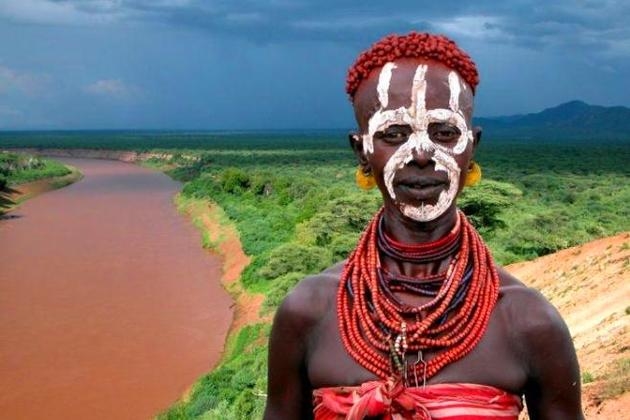
The KaroThe Karo, who number only about 3,000 people, mainly live on the practice of flood retreat cultivation on the banks of the Omo River in South-western Ethiopia. The Karo excel in face and body painting, practiced in preparation of their dances and ceremonies. They pulverize locally found white chalk, yellow mineral rock, red iron ore and black charcoal to decorate their bodies, often imitating the spotted plumage of a guinea fowl. Feather plumes are inserted in their clay hair buns to complete the look. The clay hair bun can take up to three days to construct and is usually re-made every three to six months. Their painted facemasks are spectacular. Karo women scarify their chests to beautify themselves. Scars are cut with a knife and ash is rubbed in to produce a raised welt. The Karo tribes' existence is somewhat precarious today. The inevitability of the encroaching populace and the introduction of modern weaponry have affected their already delicate ecosystem. Being the smallest tribe in the area, this group obviously struggles with direct threats from nearby tribes that have more gun power, greater numbers, and likely coalitions with one another.
Tour Code: RST/CUL/0012
Title: Travel on the Unique and colorful tribal culture of Southern Ethiopia
Mode of transport: Surface
Tour Duration: 9Day/8Night
Day 1: ADDIS ABABA
Arrive Addis Ababa and transfer to selected hotel. Overnight: @ Hotel
Day 2: ARBAMINCH
Drive to Arbaminch on the way visit the Dorze tribes for their unique Bamboo huts and their traditional weaving system. And then continue driving enjoying the fresh air, Overnight @ Hotel
Day 3: ARBAMINCH – NECHSAR N. PARK — CHENCHA MOUNTAIN- ARBAMINCH
After having breakfast you will drive to Nechsar National Park and boat ride on Lake Chamo to see the largest crocodile in Africa and Hippos. After lunch drive to Chencha Mountain to see the traditional house of Dorze tribes and their local market. Then back to Arbaminch. Overnight: @ Hotel
Day 4: JINKA
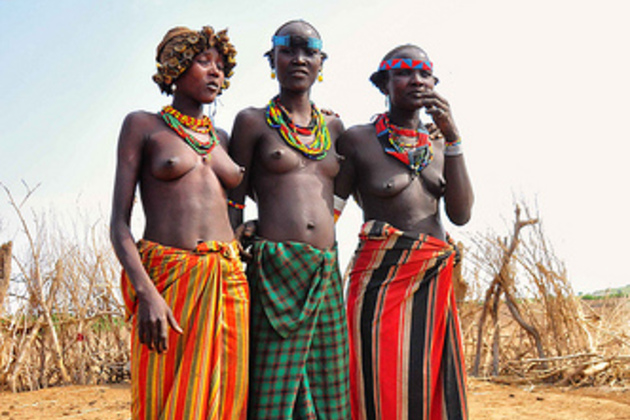
In the morning drive to Jinka, with short stop to Ari, Benna, and Tsemay people, who are very famous for their hairstyles, unique culture and traditions as well as the ornaments they put all over their body for decoration. Proceed to Jinka for an overnight hotel
Day 5: JINKA — MURSI – JINKA — TURMI
Morning drives to Mursi village situated in Mego National Park where you can see their interesting culture like women when age reaches about 17, silt is cut between lower lip and mouth. Drive back to Jinka then drive to Turmi through Dimeka village. Overnight: @ Lodge
Day 6: TURMI-KORCH-OMORATE-TURMI
Morning drives to Korch to visit Karo tribes. Here the Karo people are best for their elaborating body painting they indulge in before important ceremonies. In the afternoon take a split drive to Omorate to visit the Geleb (Desench) tribes. Back to Turmi overnight in Lodge
Day 7: TURMI — ARBAMINCH
Drive to Arbaminch on the way visit Erbore tribe their village and Konso people their unique terracing agriculture which is classified by UNESCO as a World Heritage Site and then continue driving to Arbaminch. Overnight: @ Hotel
Day 8: ARBAMINCH – ADDIS ABABA
Drive to Addis Ababa towards Sodo via Butajira, on the way visit Tiya Stele classified by UNESCO as a World Heritage Site. These steles are believed to have been erected between the 12th and 14th centuries and are almost certainly grave markers, then continue driving to Addis Ababa. Overnight: @ Hotel
Day 9: ADDIS ABABA
In the morning start city tour of Addis Ababa, visit National Museum (there is replica of Lucy, is estimated to have lived 3.2 million years ago. The specimen was discovered in 1974 at Hadar in the Awash Valley of Ethiopia's Afar Depression), Ethnography Museum in Addis Ababa University, Holy Trinity church known in Amharic as ‘Kidist Selassie”, is the highest ranking Orthodox Cathedral in Addis Ababa, Ethiopia. Then toy visit Merkato (biggest open market in Africa), Entoto St. Mary Church, Palace and Museum. At night dinner invitation by our company Right Spot travel and Tour at a traditional restaurant, then transfer in to the Airport for your international departure
In order to book this experience, please contact us through the internal message system or contact Excursiopedia.com directly!


