Book your 2026 & 2027 adventures Risk free.
Aconcagua 18 Days Climb

Select a Trip Month
Nov 24 - Dec 11, 2026
$6,790 per person
10 spots left
Dec 02 - 19, 2026
$6,790 per person
10 spots left
Dec 08 - 25, 2026
$6,790 per person
10 spots left
Dec 15, 2026 - Jan 01, 2027
$6,790 per person
10 spots left
Dec 22, 2026 - Jan 08, 2027
$6,790 per person
10 spots left

    What's Included?

  • 18-day expedition with professional, certified mountain guides
  • All ground transportation
  • 2 nights hotel accommodation in Mendoza (3-star) with breakfast
    *
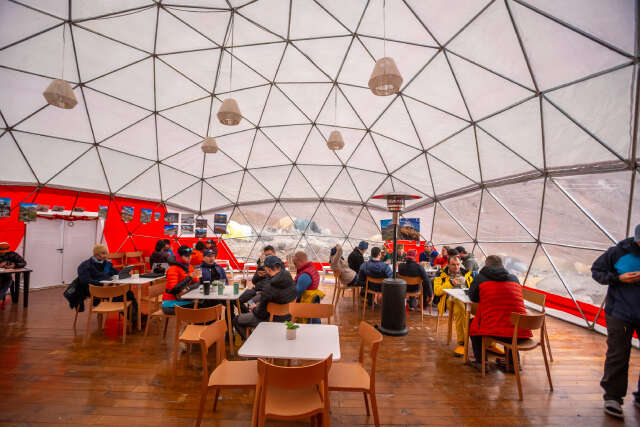
  • All meals in fully equipped dome tents
    *
  • Accommodation in double/triple tents or dormitory domes
    **
  • Load transportation by mules - up to 15kg of personal equipment (Puente de Inca to Plaza de Mulas, round trip)
  • Exclusive restroom and shower facilities at base camps
  • Purified drinking water (hot and cold) at all base camps
  • Wi-Fi internet and device charging at camps (subject to availability)
  • Equipment storage at Puente de Inca and Plaza de Mulas
  • Medical equipment at base camps (oximeters, oxygen, hyperbaric chamber)
  • VHF/UHF and satellite communication systems between all camps
  • Assistance with Aconcagua Park permit process
  • Porter service for common expedition equipment, garbage, and waste removal
  • 2 reserve days built into the itinerary for weather contingencies


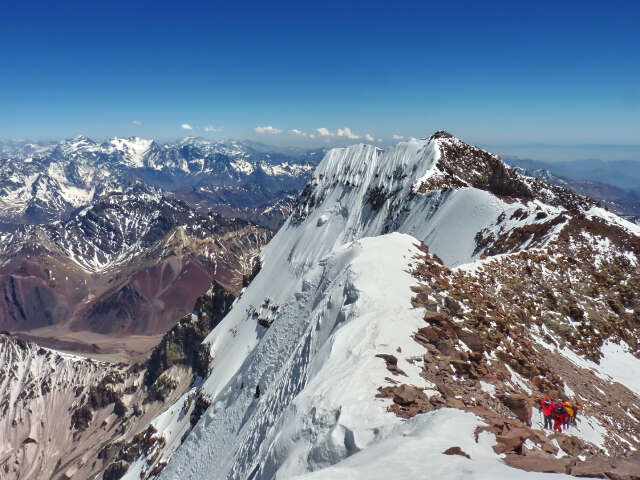
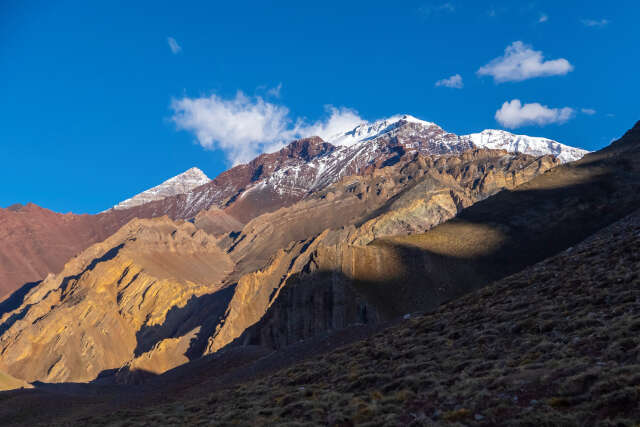
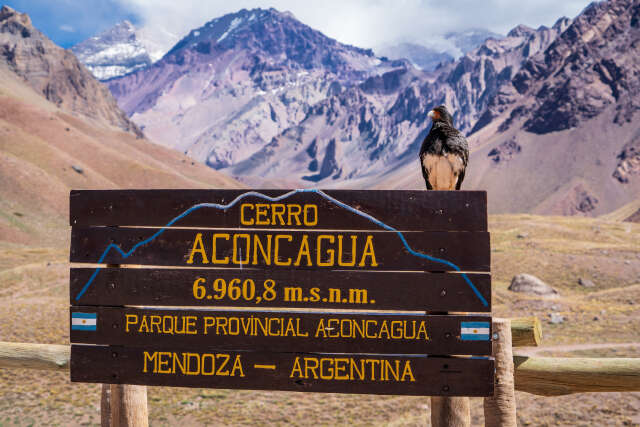
Standing at 6,962 meters (22,841 feet), Aconcagua is the highest peak in the Western Hemisphere and the tallest mountain outside of Asia - one of the legendary Seven Summits. Located in the Argentinian Andes this mighty peak offers a non-technical yet physically demanding climb that tests your endurance, mental strength, and high-altitude resilience. The Normal Route follows a spectacular approach through dramatic Andean landscapes to the vibrant base camp at Plaza de Mulas before ascending through a series of progressively higher camps toward the roof of the Americas.

Our 18-day expedition is carefully designed to balance proper acclimatization with summit success. Using the proven "climb high, sleep low" technique, you'll gradually adapt to the altitude while enjoying full-service base camps, professionally prepared meals, and the guidance of certified mountain professionals who know Aconcagua intimately. From the awe-inspiring south face viewpoint at Plaza Francia to the breathtaking 360° panorama from the summit, this is a life-changing expedition for experienced trekkers and aspiring mountaineers ready to push their limits on one of the world's great peaks.
 
* Special dietary menus (vegetarian, celiac, etc.) available at no extra cost ? just let us know in advance.
** Private tents and accommodation upgrades in Mendoza available upon request
*** Aconcagua Park entrance permit is NOT included and varies by nationality

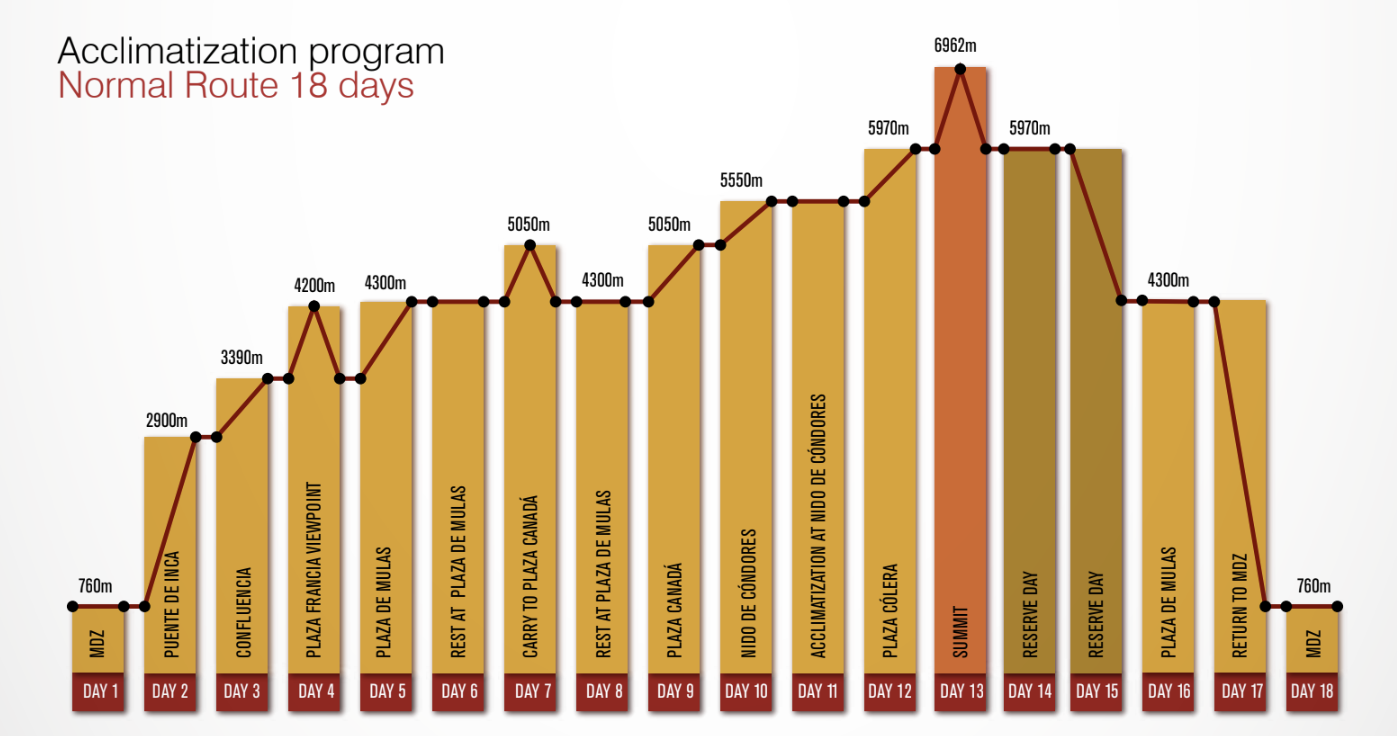
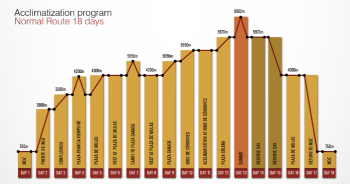
Aconcagua Climb Route Profile

DAY 1 - MENDOZA

Altitude: 760 m
Our expedition begins in Mendoza, Argentina. On your arrival at the international airport, an AdventureHero representative will be waiting for you. After receiving you, we'll drive you to your hotel. Once you've settled in, a group meeting will follow where you'll be introduced to your guides and team members.
Accommodation: Hotel double or triple room | Transportation: Airport - Hotel in Mendoza

DAY 2 - MENDOZA / PUENTE DE INCA

Altitude: 2,900 m
After breakfast, we visit the local office to collect entry permits and finalize any remaining logistics. Once everything is sorted, a minibus takes us through spectacular Andean scenery to our logistics center in Puente de Inca, 180 km into the mountains. Here we organize loads for the mules and settle in for the night.
Transportation: Mendoza - Puente de Inca | Meals: Breakfast & Dinner

DAY 3 - PUENTE DE INCA / CONFLUENCIA

Altitude: 3,390 m
After a night in Puente de Inca, we are transported to the Horcones entrance of Aconcagua Provincial Park. We present our permits at the park ranger station and begin a 4-5 hour trek to Confluencia. During almost the entire trek, you'll be treated to imposing views of Aconcagua's south face.
Transportation: Puente de Inca - Horcones | Accommodation: Double/Triple Tents or Dormitory Dome | Meals: Breakfast, Lunch Box & Dinner

DAY 4 - TREKKING TO PLAZA FRANCIA VIEWPOINT

Altitude: 4,200 m
This acclimatization day is one of the highlights of the expedition. We trek approximately 5 hours to the Plaza Francia Viewpoint, where you'll enjoy a breathtaking first view of Aconcagua's legendary South Wall - one of the most impressive mountain faces in the world. This is a moment you'll never forget.
Accommodation: Double/Triple Tents or Dormitory Dome | Meals: Breakfast, Lunch Box & Dinner

DAY 5 - TREKKING TO PLAZA DE MULAS

Altitude: 4,300 m
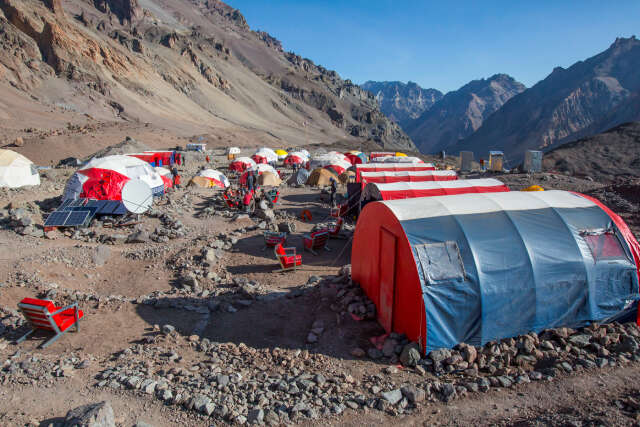
After an early breakfast, we say goodbye to Confluencia and begin an 8-9 hour hike, crossing the "Playa Ancha" and climbing the steep "Cuesta Brava." We arrive at Plaza de Mulas, the largest campsite in Aconcagua Park - a true town in the heart of the mountain. The staff will receive us with a welcome meal, well deserved after the day's effort.
Accommodation: Double/Triple Tents or Dormitory Dome | Meals: Breakfast, Lunch Box & Dinner

DAY 6 - REST DAY AT PLAZA DE MULAS

Altitude: 4,300 m
The first day at Base Camp is a day of rest and a good time to take a shower and explore the area. Together with the guides, we divide the loads that we will carry the next day to the high camps - common equipment and food.
Accommodation: Double/Triple Tents or Dormitory Dome | Meals: Breakfast, Lunch & Dinner

DAY 7 - CARRY EQUIPMENT TO CAMP 1

Altitude: 5,050 m
Today we face the challenge of gaining almost 700 m of altitude with a load on easy terrain, then returning to rest at Base Camp. We carry equipment and food strategically so that as we ascend to the highest camps, our backpacks become lighter. This also helps with acclimatization and improves our chances of reaching the summit.
Accommodation: Double/Triple Tents or Dormitory Dome | Meals: Breakfast, Lunch & Dinner

DAY 8 - REST DAY AT PLAZA DE MULAS

Altitude: 4,300 m
After the hard days of carrying and climbing, we rest and recover energy at Base Camp. We want everyone to have the best possible chance to acclimatize and achieve summit success.
Accommodation: Double/Triple Tents or Dormitory Dome | Meals: Breakfast, Lunch & Dinner

DAY 9 - ASCENT TO CAMP 1 "PLAZA CANADÁ"

Altitude: 5,050 m
We begin our ascent to the high camps on Aconcagua, moving to Camp 1, called "Plaza Canadá." Up to this point, we've been working on achieving optimal acclimatization - now it's time to take advantage of it.
Accommodation: Double/Triple Tents | Meals: Breakfast, Lunch & Dinner

DAY 10 - ASCENT TO CAMP 2 "NIDO DE CÓNDORES"

Altitude: 5,550 m
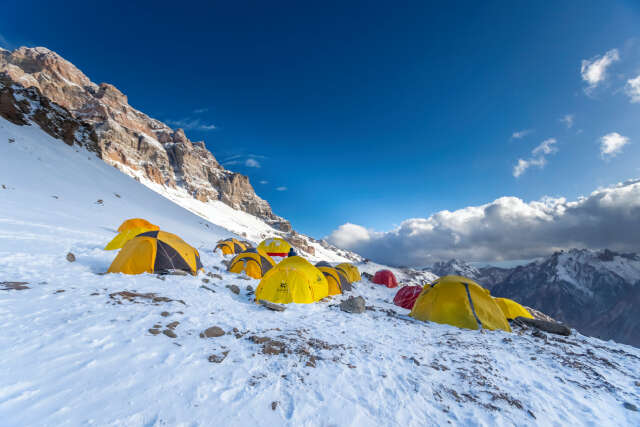
Camp 2, called "Nido de Cóndores," is located at 5,550 meters and offers spectacular views of the surrounding mountains and sunsets over the Pacific Ocean. We will spend the next two nights at this campsite.
Accommodation: Double/Triple Tents | Meals: Breakfast, Lunch & Dinner

DAY 11 - ACCLIMATIZATION AT CAMP 2

Altitude: 5,550 m
This day is dedicated to improving acclimatization to altitude. The guide may propose different activities according to the condition of the group. We take the opportunity to rest and give our bodies more time to adjust.
Accommodation: Double/Triple Tents | Meals: Breakfast, Lunch & Dinner

DAY 12 - ASCENT TO CAMP 3 "PLAZA CÓLERA"

Altitude: 5,970 m
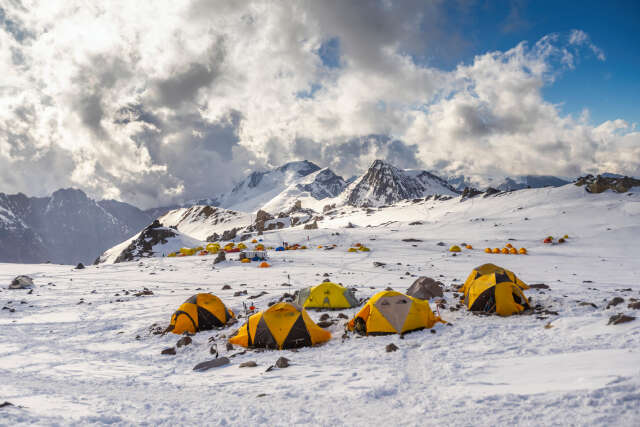
We begin a four-hour hike to Camp 3, located on the North Ridge. This is the last camp before the summit attempt. Upon arrival, we set up tents, eat, and rest to be in optimal condition. The guide individually reviews each member of the group and gives final recommendations. We also plan the final strategies for summit day.
Accommodation: Double/Triple Tents | Meals: Breakfast, Lunch & Dinner

DAY 13 - SUMMIT DAY

Altitude: 6,962 m
The day begins very early in the morning. This is the most demanding day of the expedition. We continue along the Normal Route to Refugio Independencia (6,380 m), where we usually see the first rays of sunlight. We ascend to the "Portezuelo del Viento" where strong winds are common, even on calm days. We continue along the western face to reach "La Canaleta," a steep 300-meter slope leading to the edge of the summit. From here, we advance along the Filo del Guanaco until we reach the summit at 6,962 meters - a 360° panoramic view awaits, including the imposing south face. The emotion is indescribable. After sharing these unforgettable moments, we begin the descent back to Camp 3.
Accommodation: Double/Triple Tents | Meals: Breakfast, Lunch & Dinner

DAY 14/15 - RESERVE DAYS

Our itinerary includes two additional days for the summit attempt, providing greater opportunities to reach the summit in case of adverse weather conditions or acclimatization needs.
Accommodation: Double/Triple Tents | Meals: Breakfast, Lunch & Dinner

DAY 16 - RETURN TO PLAZA DE MULAS

Altitude: 4,300 m
We descend from Camp 3 to Plaza de Mulas to enjoy a well-deserved dinner and celebrate the ascent in the comfort of Base Camp.
Accommodation: Double/Triple Tents or Dormitory Dome | Meals: Breakfast, Lunch & Dinner

DAY 17 - DESCENT TO PUENTE DE INCA / MENDOZA

We have breakfast and then start the descent from Plaza de Mulas to Puente de Inca. A private transport will be waiting to take us to the hotel in Mendoza City.
Transportation: Horcones - Puente de Inca - Mendoza | Accommodation: Hotel in Mendoza (double or triple room) | Meals: Breakfast, Lunch Box

DAY 18 - MENDOZA

Breakfast at the hotel. End of services.
Accommodation: Not included | Meals: Breakfast
At AdventureHero, we love to trek!

FAQ

The basics
Why Choose AdventureHero for Aconcagua?

We partner with the most experienced Aconcagua specialists in Argentina, with over 30 years of proven summit success and an impeccable safety record. Our guides are certified by the Provincial School for Mountain and Trekking Guides (EPGAMT) and authorized by Aconcagua Park Authorities. We provide the best infrastructure on the mountain, including fully equipped base camps, dining domes, medical equipment, and satellite communications. You can contact us 24/7 on our international helpline.

What is the Best Season to Climb Aconcagua?

The climbing season for Aconcagua runs from mid-November through mid-March, with December through February being the peak months. January typically offers the most stable weather windows. Outside this season, the park is closed to climbers.

Are all departures guaranteed to run?

Yes. Our scheduled expedition departures are 100% guaranteed to run regardless of group size.

Why is this an 18-day itinerary?

This program is designed for the proper balance between acclimatization time and summit success. It includes two reserve days for weather contingencies, giving you the highest possible chance of reaching the summit safely. The "climb high, sleep low" acclimatization protocol used throughout has been refined over decades of expedition experience.

Who can go?
What climbing experience do I need?

Aconcagua via the Normal Route is non-technical - no ropes, glacier travel, or technical climbing skills are required. However, you should have prior high-altitude trekking experience (ideally above 4,000 m), experience with crampons and an ice axe, and a high level of physical fitness. Previous experience on peaks like Kilimanjaro, Mount Blanc, or other 5,000–6,000 m peaks is strongly recommended.

Are there any age restrictions?

Aconcagua Park requires climbers to be at least 14 years old (with parental authorization for minors). There is no upper age limit, but participants should be in excellent physical condition and have relevant mountain experience.

Can solo climbers join a group expedition?

Absolutely. Our scheduled departures are group expeditions and we welcome solo climbers. There are no extra fees for solo travelers. You'll be paired with other climbers in shared tents.

Payments & Permits
What does the Aconcagua Park permit cost?

The park entrance permit (ascent fee) varies by nationality, season (high/mid/low), and route. Fees are set by the provincial government and change each season. We will provide you with current pricing and assist you in obtaining your permit (in 2025 this permit varied in price between $950 and $1200). If you book through us, you may receive a discounted rate.

When do I pay the remainder of the trip cost?

We accept payment by bank transfer, major credit cards, or cash in major currencies. Please note there may be a surcharge for credit card payments. Full balance is due either in Mendoza on arrival or should be arranged at least 15 days before arriving in Argentina.

What extra costs can I expect?

Beyond the park permit and mandatory insurance, extra costs are mainly personal - tips for guides, personal porter service if desired, drinks, extra meals in Mendoza, and souvenirs. Our package is comprehensive, so there are few surprises.

Physical Fitness & Preparation
How physically demanding is this climb?

Aconcagua is extremely physically demanding. While it's non-technical, the altitude (nearly 7,000 m), sustained elevation gains with a loaded pack, and potential for extreme cold and wind make it a serious undertaking. You should be able to hike 8–10 hours with a pack on steep terrain and have excellent cardiovascular fitness.

What is the best way to train for Aconcagua?

Focus on cardiovascular endurance (running, cycling, stair climbing), strength training (especially legs and core), and back-to-back long hikes with a weighted pack. Training at altitude if possible is very beneficial. Some climbers use hypoxic tents to pre-acclimatize at home for 4–6 weeks before the expedition.

What about altitude sickness?

Altitude sickness can affect anyone regardless of fitness level. Our itinerary is specifically designed with gradual altitude gains and the "climb high, sleep low" technique to minimize risk. Our guides monitor every team member daily and have medical equipment including oximeters, oxygen, and a hyperbaric chamber at base camp. If symptoms become severe, descent is immediate and non-negotiable.

Should I use Diamox or other altitude medication?

Some climbers use Acetazolamide (Diamox) to help with acclimatization. We recommend consulting your physician before the trip. Our guides can advise on altitude management strategies during the expedition.

Arrival & Logistics
Will someone pick me up at the airport?

Yes. Our representative will meet you at Mendoza International Airport (MDZ) and transfer you to your hotel.

Do I need a visa for Argentina?

Visa requirements vary by nationality. Many nationalities can enter Argentina visa-free for up to 90 days. Check with your local Argentine consulate or embassy for current requirements well in advance of your trip.

What is the hotel like in Mendoza?

We use a comfortable 3-star hotel in central Mendoza. Accommodation is double or triple occupancy with breakfast included. Upgrades to a 5-star hotel with a single room are available as part of our upgrade package.

Can I arrive early or stay longer in Mendoza?

Absolutely. We can arrange extra hotel nights at additional cost. Mendoza is a wonderful city known for its wine country, and many climbers add a day or two before or after the expedition.

On the Mountain
What kind of meals are provided?

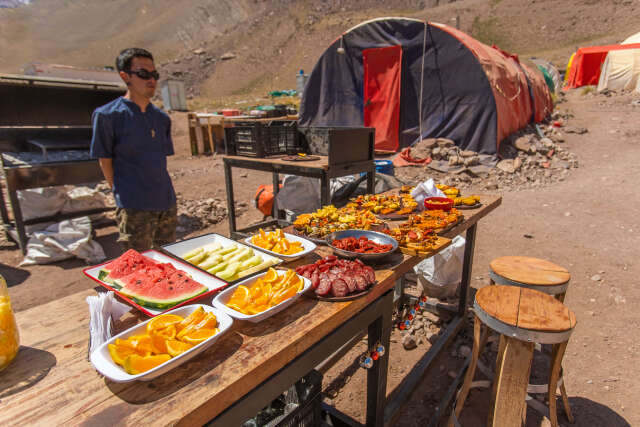
At Base Camp, our dedicated cooks prepare fresh meals daily including fresh fruit, meat, chicken, vegetables, eggs, pasta, and bread - all transported in our own refrigerated vehicles. At high altitude camps, guides prepare meals using expedition provisions and high-altitude kitchens. Vegetarian, celiac, and other dietary needs are accommodated at no extra charge.

What are the sleeping arrangements?

At base camps, you'll stay in double or triple tents or dormitory domes (4-8 person domes with bunk beds, 20 cm mattresses, carpeted floors, and electric lights). At high camps, accommodation is in double/triple tents. We include sleeping mats for extra comfort. You must bring your own expedition sleeping bag.

Is there internet or phone service on the mountain?

We offer satellite Wi-Fi at base camp and high altitude camps, subject to availability. You can also charge your devices for free thanks to our solar panel infrastructure. Satellite phone communication is maintained between all camps for safety.

What about showers and hygiene?

Hot showers are available at Plaza de Mulas base camp via solar water heaters. Exclusive restroom facilities are provided at all camps. At high altitude, restroom facilities are basic but private.

How cold does it get?

Temperatures at base camp (4,300 m) can range from -10°C to +15°C (15°F to 50°F) depending on the time of day and season. At high camps and on summit day, temperatures can plummet to -30°C (-22°F) or colder, with wind chill making it feel significantly worse. Proper expedition-grade gear is essential. Aside from altitude the cold weather is the next biggest challenge on the mountain.

How does the "Bad Weather" insurance work?

We work hard so that our clients have the greatest chance of success on Aconcagua. However, if due to bad weather conditions in the mountain and no one in the group is able to reach the Summit of the Aconcagua during the normal days of the program; you will have the unique opportunity of joining one of our subsequent groups with a 50% discount! Note: This is a unique opportunity that we offer. You still need to get travel insurance to cover your trip.

Health & Safety
What safety measures are in place?

Our guides are certified by EPGAMT and authorized by Aconcagua Park Authorities. We maintain medical kits at base camp with oximeters, oxygen tubes, and hyperbaric chambers. VHF/UHF radio and satellite internet provide constant communication between all camps, our logistics center, and the Mendoza office. We have our own contingency plan for search and evacuation.

What happens if I can't continue the climb?

If you need to descend for health or other reasons, our team will assist you back to base camp and arrange transport to Mendoza. Additional expenses for early evacuation (mule transport, extra vehicle transfers) are not included in the package and are the climber's responsibility. This is why mandatory rescue/evacuation insurance is required.

What immunizations do I need?

No special vaccinations are required for Argentina. We recommend being up to date on routine vaccinations and consulting your doctor about your personal health needs for a high-altitude expedition.

Is rescue insurance really mandatory?

Yes. You must have insurance that specifically covers helicopter rescue and evacuation at high altitude. This is a park requirement and a condition of joining the expedition. Standard travel insurance usually does not cover this - make sure your policy explicitly includes high-altitude mountaineering evacuation.

Practical matters
How much should I tip the guides?

Tipping is not mandatory but is customary and always appreciated. A reasonable guideline is $10-20 per day for the lead guide and $5-10 per day for assistant guides and support staff, depending on the quality of service.

Can I hire a personal porter?

Yes. Personal porter service is available at additional cost. This includes transport of your personal gear (up to 20kg) to all high camps and assembly/disassembly of your tent. Contact us to add this to your package.

What if the weather prevents a summit attempt?

Our itinerary includes two reserve days specifically for weather contingencies. If the weather still doesn't cooperate within those days, the guides will make the final call on safety. Refunds for unused reserve days or abandoned summit attempts are not provided, which is why travel insurance is strongly recommended.

How many people are in a group?

Our scheduled expedition groups are kept small for safety and personalized attention. Contact us for current group size details and guide-to-climber ratios.

What currency should I bring?

US dollars are widely accepted in Mendoza and useful for tips and personal expenses on the mountain. Argentine pesos are needed for some purchases in the city. Credit cards are accepted at most hotels and restaurants in Mendoza.